
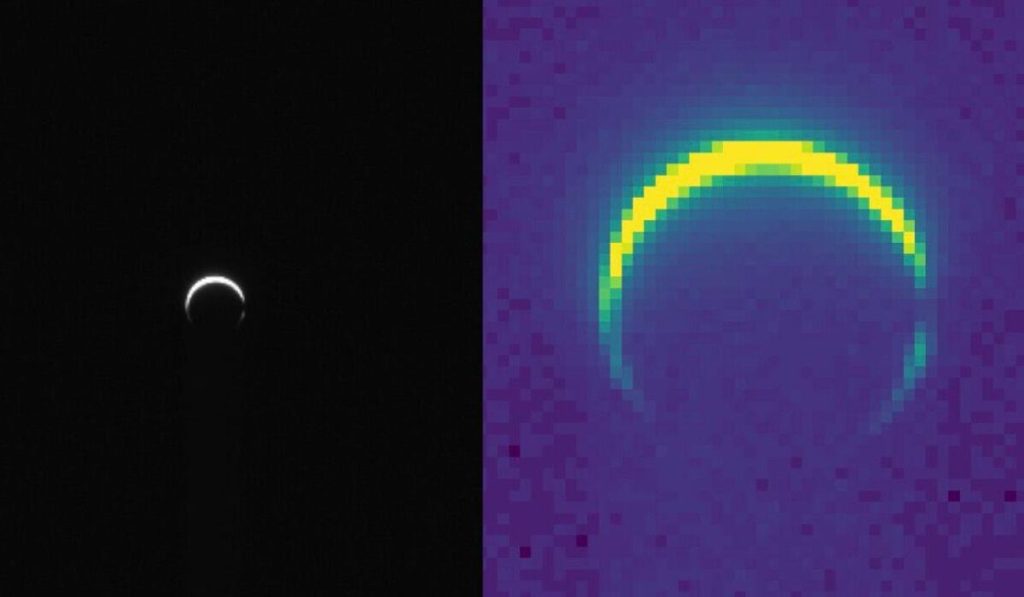
NASA Captures Rare Crescent-Moon Image of Mars During Psyche Mission
What Happened During — NASA’s Psyche spacecraft has recently taken a rare and striking image of Mars in a crescent phase, capturing the red planet in a shape reminiscent of Earth’s moon. The photo was taken on 3 Mei 2026, from a distance of approximately 4.8 juta kilometer, using the multispectral imager. This unique event marks a critical phase in the mission’s journey, which is set to reach its target, asteroid Psyche, by 2029. The crescent image not only highlights the scientific precision of the mission but also provides a rare opportunity to study Mars’ atmospheric and surface dynamics.
Gravity Assist Maneuver and Its Significance
What Happened During the gravity assist maneuver on 15 Mei 2026, the Psyche spacecraft will pass within 4.5 km of Mars’ surface at a speed of 19.848 km/jam. The resulting image displays a thin, luminous crescent, which closely resembles the moon’s crescent as viewed from Earth. This phenomenon occurs due to the spacecraft’s position relative to the sun, creating a high phase angle that allows for such an unusual perspective. The crescent is formed by the interplay of sunlight reflecting off Mars’ surface and the scattering of dust particles in its atmosphere, which amplifies the visual effect.
The brief exposure time of just 2 milidetik was enough to capture the delicate details of the crescent, despite the challenges of light saturation. This moment is significant not only for its aesthetic value but also for its scientific importance. The image serves as a test of the spacecraft’s imaging capabilities, ensuring that the multispectral imager can accurately capture data during the mission’s long journey to asteroid Psyche. By analyzing this crescent, scientists can better understand how light interacts with Mars’ surface and atmosphere, which may help in interpreting future observations of the planet.
Scientific Insights and Mission Objectives
The crescent image of Mars offers more than just a rare visual treat; it is a valuable tool for scientific analysis. According to NASA’s observations, the crescent’s shape and brightness provide clues about the planet’s surface composition and atmospheric conditions. The slight curvature of the crescent is influenced by the angle of sunlight and the distribution of dust in Mars’ atmosphere, which can affect how light is scattered and reflected. This insight helps researchers refine models for planetary observation and improve the accuracy of data collected by the spacecraft.
“The crescent phase is an opportunity to study how light behaves in Mars’ atmosphere and surface,” explained NASA scientists. “It’s a rare event that allows us to test our instruments and gain a deeper understanding of the planet’s properties.”
By capturing this image, the Psyche team can validate the performance of the multispectral imager, which is crucial for the mission’s long-term success. The data gathered during this maneuver will be used to calibrate the camera and ensure it is ready for the more complex tasks ahead, such as analyzing asteroid Psyche’s metallic surface and its potential as a remnant of a planet’s core.
Technical Challenges and Mission Planning
What Happened During the mission’s approach to Mars also involved overcoming technical challenges. The high phase angle required precise positioning to capture the crescent image, as the sun’s position relative to the spacecraft and planet plays a key role in the lighting conditions. The maneuver’s timing was carefully calculated to align with Mars’ orbital path, allowing the spacecraft to use the planet’s gravity to adjust its trajectory. This technique not only conserves fuel but also optimizes the mission’s route to asteroid Psyche, which lies in the main asteroid belt between Mars and Jupiter.
For the Psyche mission, the gravity assist is a strategic move to reduce the amount of xenon propellant consumed by the solar-electric propulsion system. This is essential for extending the spacecraft’s operational lifespan and ensuring it can reach its target without depleting resources prematurely. The maneuver also allows the team to simulate real-world conditions, testing how the instruments perform under varying light and atmospheric influences. Such preparation is vital for the mission’s ultimate goal of studying the composition and origin of asteroid Psyche.
Observing Mars’ Atmospheric Effects
What Happened During the imaging process also revealed how Mars’ atmosphere interacts with sunlight. The scattered dust particles in the thin Martian atmosphere contribute to the crescent’s width, making it appear broader than it would under clearer conditions. This effect is a result of the planet’s atmospheric scattering, which is more pronounced at certain angles. The image’s clarity, despite these challenges, demonstrates the robustness of the multispectral imager and its ability to capture high-quality data even in complex environments.
The crescent image also provides a unique perspective on Mars’ geography. The dark shadow on the right side of the crescent, as observed by NASA, aligns with the area of the north polar cap that is currently experiencing winter. This suggests the presence of seasonal clouds or frost, which can affect the planet’s albedo and thermal properties. By studying these features, scientists can better understand the climate patterns and surface changes on Mars, further enriching their knowledge of the planet’s dynamic processes.
Future Implications and Mission Timeline
The crescent image captured by the Psyche mission is a milestone in its journey toward asteroid Psyche, which is believed to be the exposed core of a protoplanet that failed to form into a full planet. What Happened During this event underscores the importance of gravitational assists in deep-space missions, as they enable spacecraft to alter their trajectory with minimal fuel consumption. The data collected will be critical for refining the mission’s trajectory and ensuring it reaches its target on schedule. This step marks a significant progress in the mission’s timeline, with the final approach to Psyche expected in 2029.
What Happened During the Psyche mission’s encounters with Mars also highlights the collaborative efforts of the scientific team. The image is a result of meticulous planning and precise execution, demonstrating the spacecraft’s advanced technology and the expertise of the mission’s engineers and scientists. As the mission moves forward, the crescent image will serve as a benchmark for future observations, helping researchers compare and analyze data across different phases of the planet’s orbit. This kind of detailed imaging is essential for unraveling the mysteries of the solar system and advancing our understanding of planetary formation processes.